Conservation Photography - My Window to a Vanishing World

Updated: Aug 27
Conservation photography is a powerful medium to provide captivating impressions of our natural world underlined with scientifically sound information. Conservation stories and documentaries not only show what is at stake. They translate why the world's natural habitats and biodiversity are threatened and share how humans from all tracks of life can make a difference. In this article I note some important facts and add my personal thoughts about why authentic conservation stories and documentaries matter. - Perhaps now more than ever, as social media is increasingly flooded with AI-generated content of dubious quality.

I started writing this as a brief introduction to the updated "Personal Favourites" gallery. The idea seemed simple: to describe what kind of photograph should make it into my Personal Favourites gallery for conservation photography. As I was structuring my thoughts, I realised this would be a perfect opportunity to re-describe the purpose and relevance of the conservation stories I share on myWilderness.net.
The term "sustainable" will not be used here, as pretty much any human activity comes at a cost that burdens the planet. Much of our impact is simply not sustainable. We must continuously ask ourselves how we can justify, and if possible, compensate the burden we cause. While I remain humble and realistic about the impact one man or even one nation can have on a population of billions, we know that many small deeds result in a significant effect.
In the words of late Archbishop Emeritus of Cape Town,
and Nobel Peace Laureate Desmond Tutu:
Do your little bit of good where you are; it's those little bits of
good put together that overwhelm the world.
To begin with, I chose .net over .com as domain for myWilderness because I use this platform to share information and connect with people, not to pursue commercial interests. There was a time when friends convinced me to submit images to wildlife photography competitions like the prestigious Natural History Museum Wildlife Photographer of the Year. But I find that this is not for me. While any material of scientific value will be made available to relevant journals, I neither photograph nor write to compete for awards.
There are occasional images showing me in a specific context, but I remain the person behind the lens. This stage belongs to the wildlife, nature, wilderness, and people I encounter on my travels. My objective is to share my fascination for the natural world and create captivating conservation stories. May they inspire visitors of all ages to learn more about wildlife and wilderness. May they provide a better understanding of the role we play and how we can support conservation efforts, from local initiatives to global long-term programs. Most of all, may it further the compassion needed to engage and drive change for the better.

17 July 2024, 20:40h - On a night-dive at Sangeang island, surrounded by black basaltic sand, thermal vents, and hardened lava flows, this Golden cuttlefish (Acanthosepion esculentum) swims up to me for a close inspection.
Why are conservation stories relevant today? What objectives are pursued?
To answer these questions, we must revisit the reasons for nature conservation to be necessary in the first place, and why society still fails at creating a world in which wildlife and wilderness do not need protection.
Any conservation effort is a stand against ignorance, greed, selfishness, and apathy. These human traits hide behind situational priorities to unfold their negative environmental and social effects across the globe day in and day out. Unchecked, they continuously degrade and destroy natural habitats and grind down our biodiversity until the bitter end. This is exactly how Anthropocene Extinction, the man-made 6th mass extinction, works. So let's dive a bit deeper.

11 August 2015, 22:03h - A leopard cat (Prionailurus bengalensis) observing its former home: an expanse of rainforest that was cleared to extend a palm oil plantation near Tabin Wildlife Resort, Sabah, Malaysian Borneo.
Where do we stand today?
Humans hold an incontestable dominance over every aspect of life on earth to an extent no other species has done before. At the moment of writing, our global headcount stood at over 8.31 billion, and it continues expanding. Many fellow members of society claim that our growth-based economic system must persist to ensure development and prosperity, thus, prevent economic collapse. Some remain convinced that future generations will simply master any ecological and social challenges by applying technological solutions to be developed in years to come.
But in this we ignore a fact of physics: there cannot be unlimited growth in a limited system. Human population growth will end. The only question to ask is at what population density level we want it to end. If anyone you know questions this, please introduce them to the work of late Dr. Albert A. Bartlett, Professor Emeritus in Nuclear Physics at Colorado University in Boulder CO, USA. Particularly Dr. Bartlett's presentation titled "Exponential Growth Arithmetic, Population and Energy".
You can find it here: YouTube Link to Dr. Albert Bartlett's presentation.

Colorado University physics professor Dr. Albert A. Bartlett worked at Los Alamos National Laboratory for the Manhattan Project in 1944 before a 38-year tenure on Colorado University's physics faculty.
There is a simple message here: the combination of human overpopulation and accelerating climate change presents the most significant ecological challenge our world is facing today. We can already observe interlinked problems leading us into uncharted ecological territory. The possible consequences? Imagine not a few hundred thousand, but tens and hundreds of millions of climate refugees. People who can no longer survive in the regions they live in today as temperatures rise beyond the point where humans and livestock can maintain a body temperature consistent with survival. Extreme droughts in one season followed by devastating floods in the next season degrading fertile land, reducing crop yields, and threatening food security. Novel bacterial outbreaks, invasive species, and parasite range expansion (I personally experienced this in early 2024). A grave reduction in pollinating insect populations. Annually occurring forest and veld fires where there were fires once every few years, or even decades. Ocean acidification destroying reefs as natural fish hatcheries, as well as open ocean zooplankton in its role at the bottom of marine food chain. Disappearing glaciers resulting in seasonally dry rivers, critical drops of groundwater tables, and water shortages with even in temperate climate zones, ... and the list goes on.

25 April 2017, 09:12h - Cashmere goats in Siilkhem, Mongolian Altai
Mongolia is facing a massive overpopulation not of humans but of livestock. The transition from ex-Soviet era planned economy to market economy combined with an increasing international demand for cashmere caused herders to considerably grow the numbers of cashmere goats relative to sheep, cattle, horses, and Bactrian camels. Goats are particularly destructive to grasslands and forests, turning dry steppe, grasslands, parts of mosaic forest landscapes, and Altai taiga into dusty deserts. More than 70% of Mongolia's ca. 1.2 million km2 pasture lands are now degraded.
The battle for access to basic resources
The earliest recorded battle for access to basic resources unfolded about 4'500 years ago in Sumer between the Tigris and Euphrates river landscapes. It was fought over more than two centuries between Lagash and Umma, two rivalling city-states lying about 60km apart in ancient Mesopotamia. Generations hurt and killed one another over a stretch of fertile land and the use of irrigation canals.

Land between the rivers - Mesopotamia
In more recent history driven be imperial and colonial ambitions, basic resource conflicts were fought on almost all inhabited land and across seas and oceans. Most or all of these conflicts dramatically intensified with the proliferation of small firearms. But they never only affected humans; until today, wherever resource conflicts unfold, wildlife inevitably loses out.
For these simple reasons:
society is not organised around science but prioritises the expansion of economic gain and power.
Current socioeconomic structures dictate that a vast number of people face an existence in poverty. Many deprived of basic dignity and meaning in their lives.
Major religious doctrines attribute humans a God-given dominion over every life and object on the planet. - Yet without requesting duty of care.
Today still, some cultures' leaders dilute, discourage, or block access to education for all or parts of their subjects.
Inevitably this must result in cultural gaps of tectonic proportions and currently insurmountable differences between peoples' value systems. For our coexistence with the natural world, this gap defines the difference between a sensible level of use guided by our duty of care for our planet and future generations vs. blind exploitation to maximise short-term profits. Blind exploitation and its terrible cousin: the armed conflict. While armed conflicts carry horrific consequences for people caught up in the crosshairs, they often leave massive environmental damage behind.
Classic examples

Rougeville, Michigan, 1892 - Thousands of skulls of Plains bison (Bison bison bison) stacked
to be ground into fertiliser by Michigan Carbon Works.
At the beginning of the 19th century, an estimated 30 million to 60 million Plains bison roamed North America. With the help of the U.S. Army, hunters nearly drove the species to extinction. By 1884, a mere 325 wild bison had survived! Tens of millions of these animals had been massacred. Along with any hope for dignified, self-determined survival of the Plains Indigenous Nations who depended on the bison and suffered starvation.
But the 19th century bison massacre represents just one face of the battle for access to resources. In this case, fought between ruthless colonial capitalists and Indigenous Nations, and wildlife in the USA. Similar patterns developed around the world, driving multiple land and marine mammals, fish, and bird species close to extinction or with outright deliberation over the edge. The common recipe for disaster: unrestricted hunting for animal products and trophies, predator extermination, and the elimination of wild competitors for livestock farming in combination with large-scale fencing that cut off seasonal migration routes and access to perennial surface water.

Farmers after a trekbokke hunt, 19th century South Africa.
During the same period, in South Africa, tens of millions of antelopes such as springbok, blesbok, and eland, and countless zebras were slaughtered in the Great Karoo, across the Free State, and the Northern Cape. One single hide merchant was reported to have sold and exported over two million springbok skins between 1878 and 1880. Police would supply subsidiesd ammunition to farmers at half-price.
The relevance of conservation stories: from information to engagement

Conservation is about engagement
Let me start with this little note in good humour:
Two conservation researchers are working in a remote and dangerous jungle. Threats have been made against them by local poachers and traffickers. Around the campfire at night one researcher nervously asks his colleague: "What if I get kidnapped for ransom? How much do you think you could raise to get me out?"
To which the other replies: "Awareness! I could raise awareness!"
Awareness is a good start. But without engagement, it won't reduce or solve any problems in life. A pilot may be well aware that he is flying on a nearly empty tank. But if no action is taken, the result will be catastrophic. The same applies to ecological and social challenges.
If my work-related experience and travels have taught me one lesson, it is that across all cultures and every track of life, we as individuals will only protect what we care about. It follows that we will only care about what we know, understand, and learn to appreciate. But what does it take to appreciate, understand, care about, and help to protect wildlife and the environment it lives in? -
While it appears that Maslow's Hierarchy of Needs has recently been extended with WiFi signal, charging spots, and AI tokens, it is clear that protecting any forest, savannah, steppe, coral reef, or any river, lake, sea, and ocean, as well as any wildlife species is extremely difficult for human beings exposed to a basic daily struggle to put a roof over their head and food on their plate. It is equally difficult in zones of armed conflicts, and sadly, in countries ruled by people who perceive wildlife research and conservation efforts to be some suspicious form of foreign meddling or espionage, rather than a meaningful contribution to life on earth.
Once basic survival is safe, education is the path to any future worth having.
Scenes from Mongolia, India, Zimbabwe, Brazil, and Chile.
Once basic levels of stability are accomplished, people must be enabled to live off the land in a way that future generations may do the same. It is from this point onwards where conservation stories become most relevant. From people who work to step out of poverty, all the way to those who accumulate immeasurable wealth: conservation stories serve to share information, further understanding, and inspire engagement. No matter how small, any kind conservation engagement is relevant if it helps preserving the environment, takes care of nature, wilderness, and wildlife, avoids further damage, and teaches future generations to do the same. -
We may not be responsible for state in which the world was handed to our generation, but we are certainly responsible for what we hand over to following generations.
All life has an equal right to live. Thus, nature conversation, or simply extending kindness to other species is not just some bunny-hugger dream. Our dominance over the natural world allows neither doubt nor debate about our responsibility for the planet. It is on our shoulders to protect and perpetuate the existence of our natural world and its biodiversity.

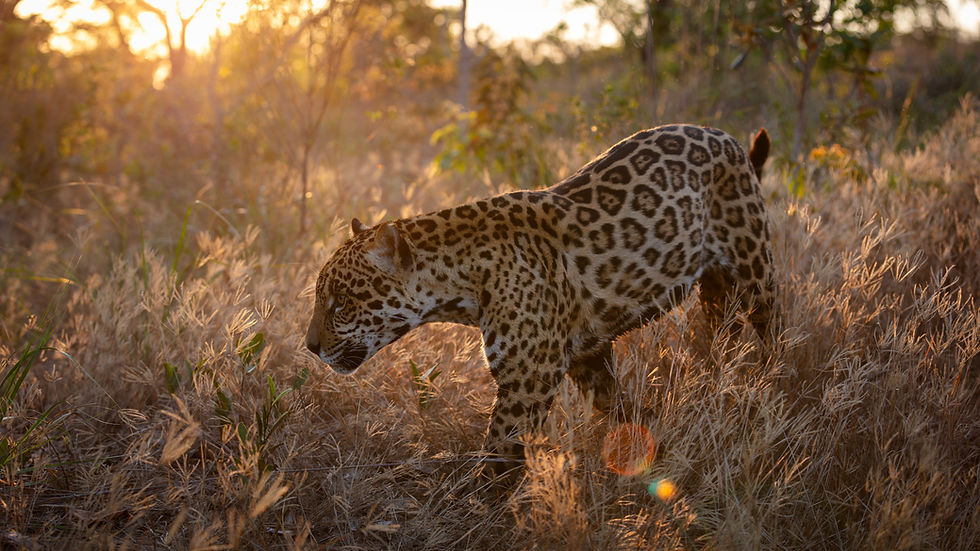
12 September 2014, 15:40h - Searching for jaguars along the shores of Rio Negro de Mato Grosso do Sul,
with our dear friend Lydia Möcklinghoff (3 Jan 1981 - 3 Jul 2026). Lydia was a leading expert on neotropical ecology, and giant anteaters in particular. She tragically lost her life in a light aircraft crash while travelling for field work.
"Why does it even matter whether any particular species survives or not? Extinction has always been part of evolution, hasn't it?"
I was asked this question over a dinner with friends on a mild August evening in 2014. We had been talking about an upcoming journey to Brazil where I had planned to initiate a small research and documentation program focussing on flood-related movement patterns of jaguars, pumas, and ocelots on a low-lying farm in the southern Pantanal.
Surprise, I remember, was my first reaction. After all, I was talking to a person who had enjoyed the highest levels of education at an internationally leading university. Surely, this person would automatically understand and attribute value to how the natural world and its biodiversity works. What Anthropocene Extinction means, and how a healthy, stable environment would benefit the foundation of all life on the planet? - But in an instant I remembered that this lady had grown up and had been educated in a way that afforded her value system very little space to entertain thoughts other than those relating to her family's wellbeing and her work in healthcare consulting. This was the core of her interests. -
A lost cause, wouldn't you think?
Far from it! Because her husband and their two children also sat at the table, and on a later occasion, her brother-in-law with his family were part of a joint dinner. All these kids were most fascinated to learn about wildlife. They drilled me endlessly with questions about my travel adventures and wanted to see ever more photographs, mostly of the charismatic big cat species. A few years later, the time had come when these kids were old enough for the families to plan a safari. We organised a self-drive adventure in southern Africa for them, combining camping, guest farms, and lodges. Malini designed a little booklet with information and ID quests for the youngsters. It was a marvellous success. These kids, and through them their parents, had become interested in nature conservation.
Multiple similar stories have been written since then. Many resulting in active support and personal engagement for conservation. All of them in sharing information that will spread and inspire others - and young people in particular.
In the words of American marine biologist Sylvia A. Earle:
Once you know what you know and you see what you see,
it is irresponsible not to do what you can to share that knowledge.

12 April 2026, 19:38h - Eureka Sound, Ellesmere Island
The face of wildlife in an environment where - due to its sheer remoteness - it currently doesn't need protection from human activity.
Why are conservation stories relevant today? What objectives are pursued?
Conservation stories are relevant because they remind us of our collective responsibility. We must ensure to hand over the flame, not just preserve the ashes for future generations. -
This is why I will invest much of my energy in years to come to further explore, learn, document, guide, and to share my fascination for natural history and the beauty and value of wildlife and wilderness on our planet.
15.08.2026
Patrick Meier


Comments